

View 1: Context engineering (the memory substrate)
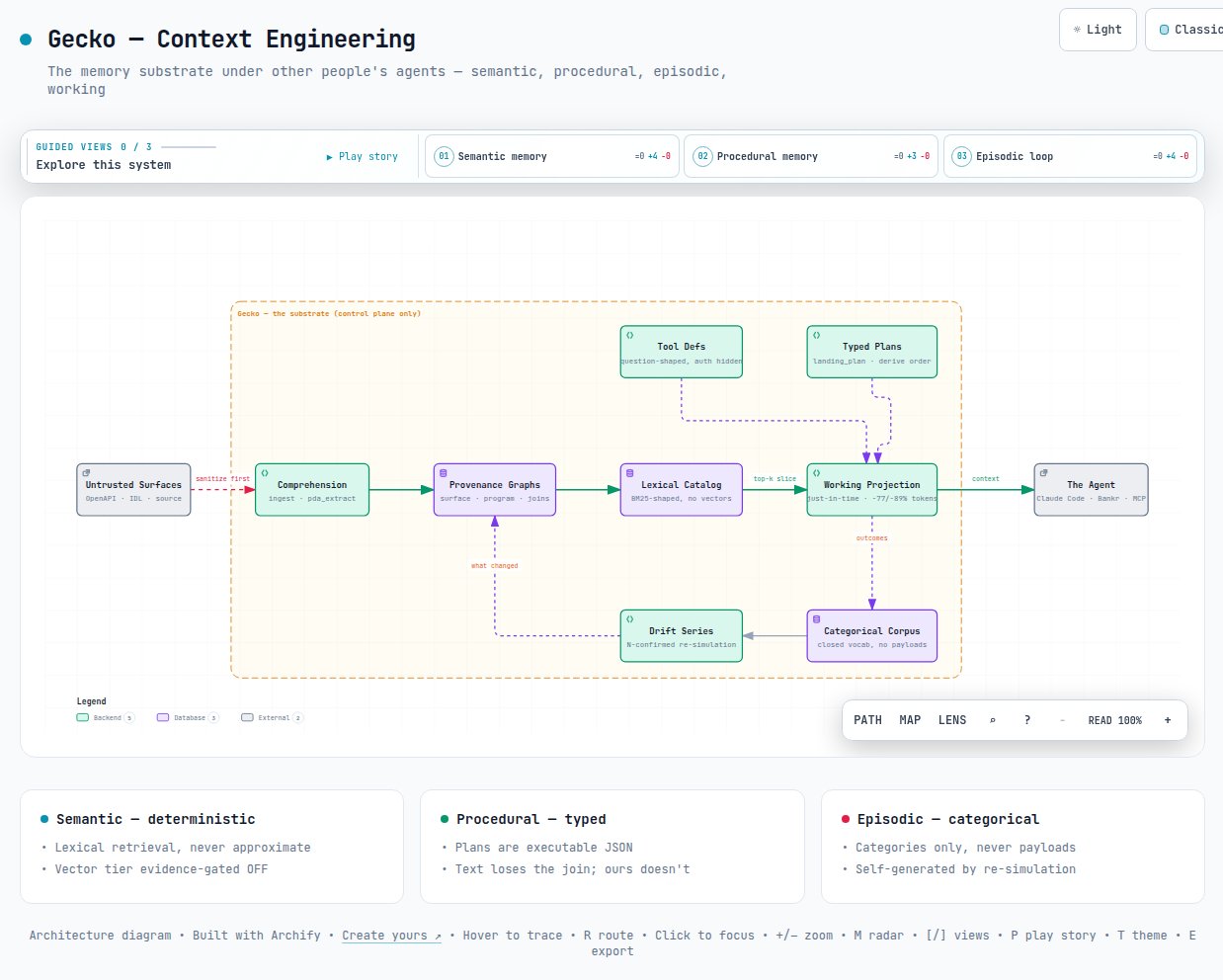
Gecko as a memory substrate: semantic, procedural, episodic, and working memory, under someone else's agent, not replacing it.
Retrieval quality is fed by a misrank-aware evaluation: a golden set plus a closed
miss-cause vocabulary, so the lexical-vs-semantic gate gets data instead of a guess.
The diagram above is a render. The interactive version (pan, zoom, guided
views, PNG/SVG export) ships in the repo as a single self-contained file:
docs/assets/architecture-context.html.
Download it and open it locally; it needs no server and no network.View 2: The full pipeline (sources → knowledge → action)
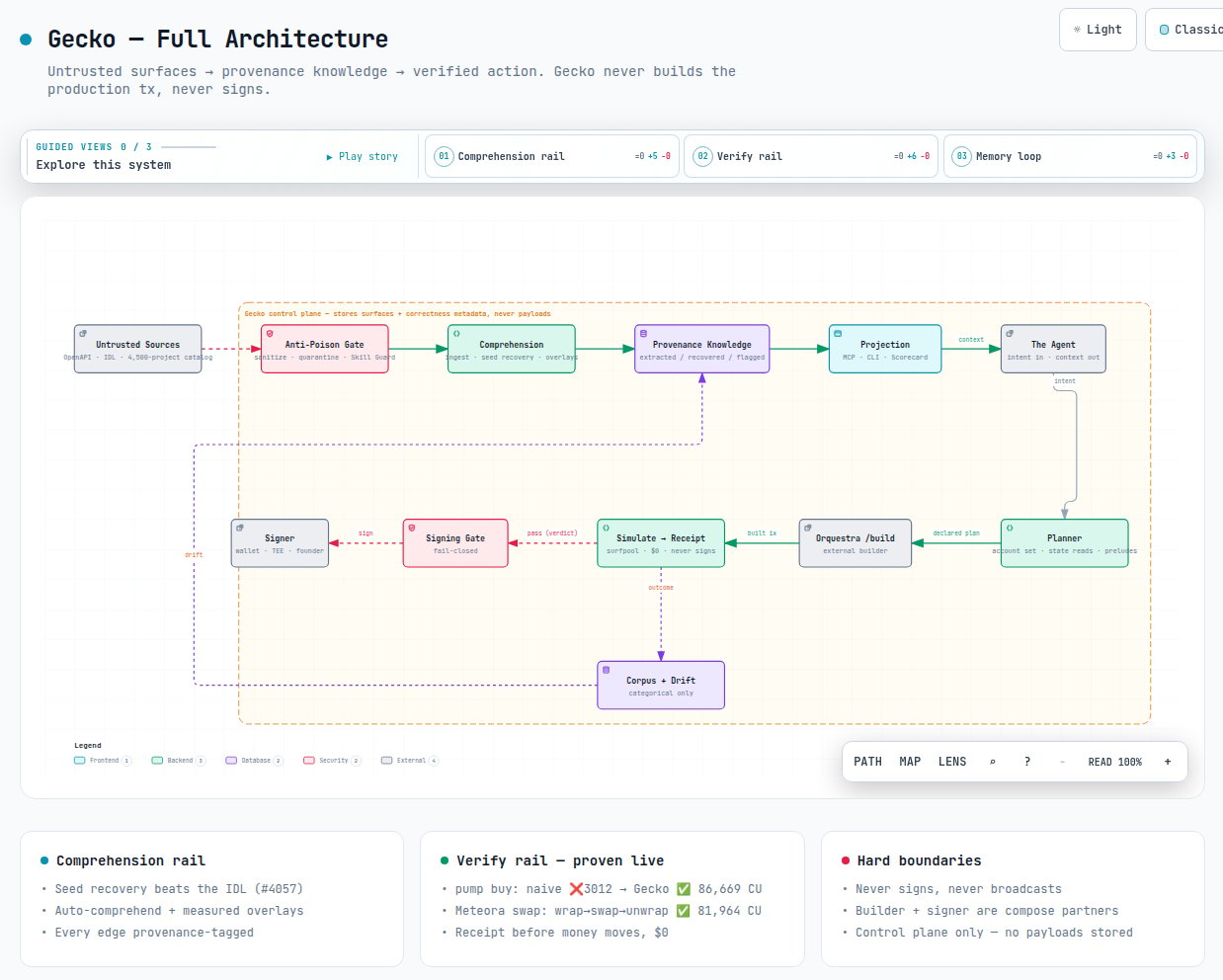
Untrusted sources pass an anti-poison gate into comprehension, become provenance-tagged graphs, project as MCP tools, and reach action only through simulate → receipt → binding.
1
Sources: all untrusted
OpenAPI, human docs,
llms.txt, Anchor IDLs, raw program source (Steel and native
too), and a 4,500-project on-chain catalog. Everything ingested is treated as
hostile input.2
Anti-poison gate
Spec sanitizer, per-tool quarantine, image Skill Guard (rendered-pixel payloads and
encoded-content rescan), SSRF netguard, out-of-band auth-host anchoring. Fail-closed.
3
Comprehension
Ingest to normalized
Operation / Param; PDA seed recovery from IDL and source
(source rescues what the IDL structurally drops); auto-comprehend on pick, which
emits a generated config plus a measured overlay of what could not be derived
from any public surface.4
Knowledge: provenance on every edge
Surface graph:
EXTRACTED > DECLARED > INFERRED > CLAIMED → VERIFIED /
REFUTED. Program graph: EXTRACTED / RECOVERED / FLAGGED. Cross-API
correlations join on declared value domains first.5
Projection
MCP (hosted, stdio, npx/uvx), the CLI, the Scorecard, and the Playground.
Auth headers never appear in a tool def.
6
Action: verify, never sign
plan_* returns the full account set plus state-read args and landing preludes → an
external builder builds → Gecko simulates the exact bytes → a Receipt with a
binding over those bytes → an external signer (wallet / TEE / human) signs →
verify_signed_transaction proves the signed bytes are the checked ones →
submit_transaction relays them, and refuses anything that does not verify.7
Learn
A categorical outcome (never a payload) can be recorded on explicit opt-in, feeding
the drift series, which feeds back into the graph.
The diagram above is a render. The interactive version (pan, zoom, guided
views, PNG/SVG export) ships in the repo as a single self-contained file:
docs/assets/architecture.html.
Download it and open it locally; it needs no server and no network.View 3: The on-chain action path (the proven loop)
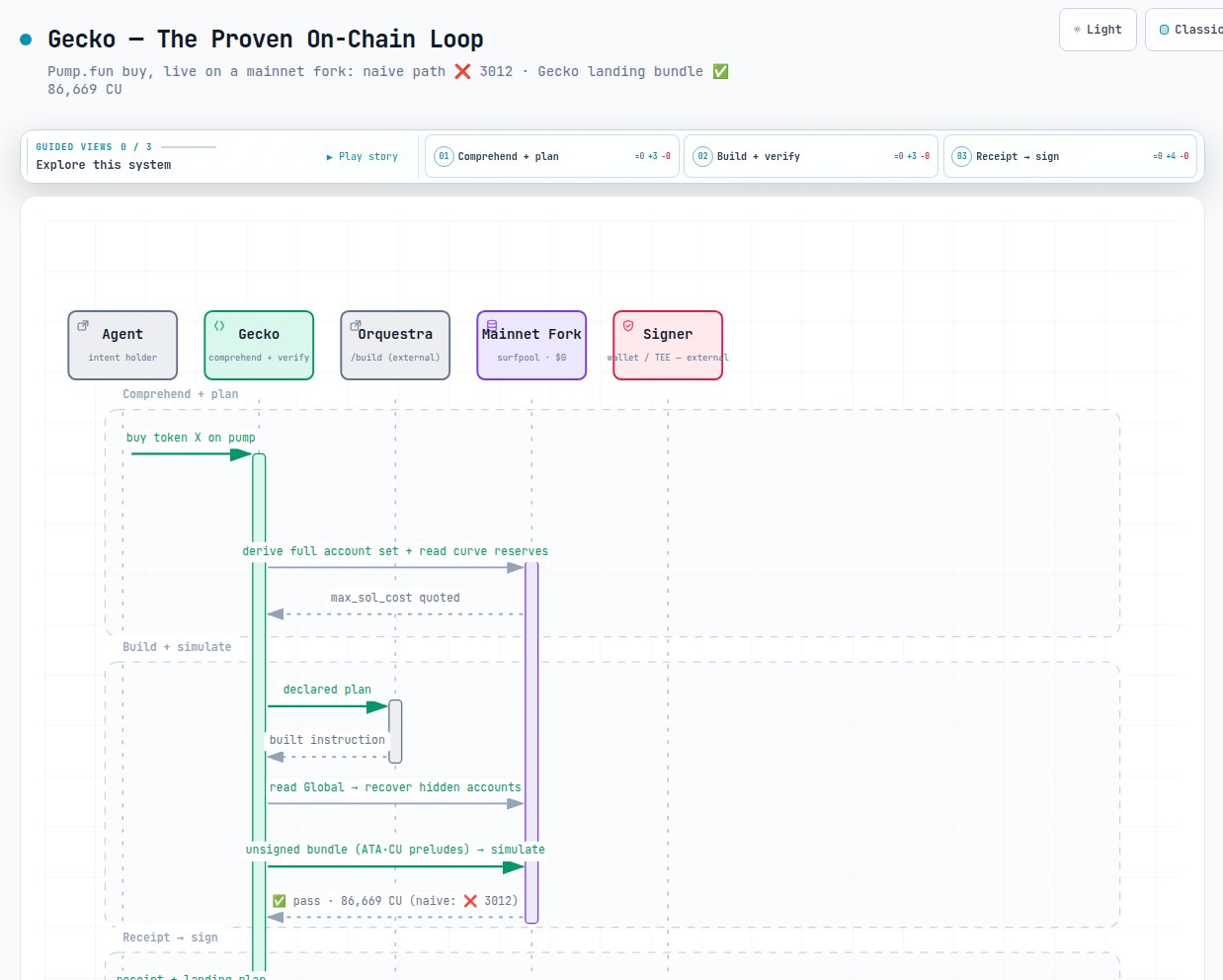
Intent → derive the full account set → state reads → external build → unsigned prelude assembly → simulate → Receipt + binding → external signer → verify → submit.
- Intent: “buy this token”, “swap SOL for USDC on this pool”.
- Derive the full account set, including accounts the IDL hides
(
bonding_curve_v2) and seeds recovered from source (base_factor). - State reads (control plane) for sane arguments, e.g. curve reserves →
max_sol_cost. - External build: the plan goes to the builder; the builder returns the instruction.
- Unsigned prelude assembly, for simulation only: idempotent ATA creation, wSOL wrap/unwrap, compute budget. On the money paths, a fresh blockhash is patched in at the offset the layout dictates, so the simulated bytes are the bytes handed back.
- Simulate:
simulateTransactionwithsigVerify:false, on a fork or against a public mainnet RPC. - Receipt + binding: status, categorical revert class, compute units, and a hash
over the exact message bytes at
exactstrength. → The Receipt - External signer signs. Then
verify_signed_transactionchecks the signed bytes against the binding, andsubmit_transactionrelays them only if that check passes.
submit_transaction, lives outside it and
is structurally unable to relay bytes without a binding.
The diagram above is a render. The interactive version (pan, zoom, guided
views, PNG/SVG export) ships in the repo as a single self-contained file:
docs/assets/architecture-onchain.html.
Download it and open it locally; it needs no server and no network.Invariants
Control plane, never data plane
Stores the API surface, tool defs, and correctness metadata only, never response
payloads, user data, or secrets.
The engine is API-agnostic
Everything API-specific reduces to data (the spec) plus one adapter seam,
Session.auth_headers(). Adding an API doesn’t touch ingest/catalog/tools/caller.One code path, two modes
recorded and live differ only at the transport edge. The free offline
simulation comes first; live smoke is the final check.Auth is invisible to the agent
Tool defs never expose auth headers. The agent describes intent; Gecko injects
credentials at call time from your OS keychain.
Never sign, never hold a key
No keypair on any path. The landing layer has no sign or send path, AST-enforced.
submit_transaction relays only signed bytes that verify against a Gecko binding.Never fabricate
Unknown facts are
FLAGGED, not invented. Below the retrieval floor the answer is
an honest no-start.Module map
The comprehension logic is the product and lives in the package; the MCP server, the client, and the scripts are thin transport.The one seam that matters
Adding a new API should not require touching ingest, catalog, tools, or the caller. The only API-specific code is, at most, an auth adapter, an object that implements:{}); a paywalled API supplies
a session that returns its tokens. See Access & auth.
Security posture
- Ingested spec, doc, IDL, and source content is treated as untrusted input.
- URLs are validated before fetching (no SSRF: private/loopback/link-local ranges and
non-http schemes blocked). A caller-supplied
rpc_urlgoes through the same guard. - Secrets resolve from the OS keychain at call time and are never logged or persisted; errors redact tokens before they’re raised.
- Seven fail-closed security layers: spec sanitizer · per-tool quarantine · image Skill Guard · SSRF netguard · out-of-band auth anchoring · the signing gate that checks signed bytes against the receipt’s binding · the AST-enforced no-sign boundary on the landing layer.
The agent-readable version of this page is
architecture.llms.txt
in the engine repo: the same three views plus the honest works / not-built split. See
also Status.