> ## Documentation Index
> Fetch the complete documentation index at: https://docs.geckovision.tech/llms.txt
> Use this file to discover all available pages before exploring further.
# Stay correct
> Drift — knowing when a provider breaks you. Content-addressed surfaces, the regenerable-tool model, the categorical corpus, and the N-confirmed drift detector. The scheduler is not built yet.
It's Saturday. Nobody shipped anything. Your agent is down anyway — upstream renamed a
field, moved a path, tightened an enum, and your hand-written client knew none of it. It
keeps sending the old shape; the API keeps returning 422; the agent keeps confidently
retrying a call that can no longer succeed.
A hand-written client is a **frozen snapshot of an API that doesn't hold still.** So is
the spec it was written from — nothing in a specification says when it stopped being true.
Every rename is a manual diff a human has to notice, read, and re-code. Multiply by the
Nth API and "keep the integrations correct" becomes a standing on-call burden.
## Why the generated-tool model changes the failure mode
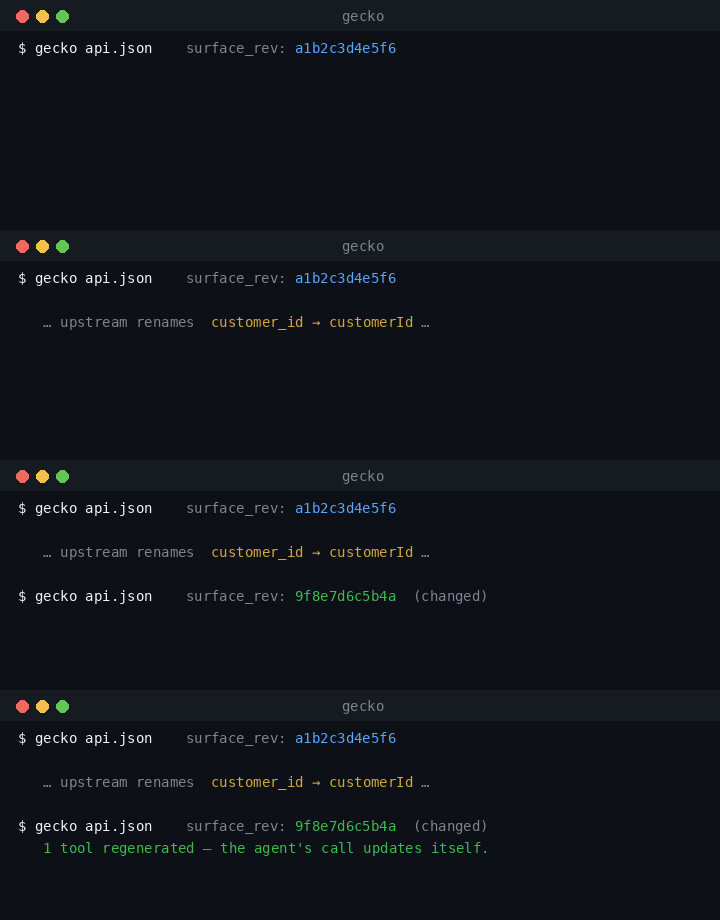
Your agent never calls a hand-written client through Gecko — it calls **tools generated
from the spec.** Tool generation is a *pure function of the surface*: same spec in, same
tools out. If the source of truth moves, the tools move with it — you re-comprehend the
surface instead of hand-editing a client.
Gecko knows which surface a tool came from, down to the revision:
```
surface_rev = sha256(canonicalized spec)[:12]
```
Same spec → same `surface_rev`; any edit bumps it. It's a content fingerprint stamped on
the cached comprehension and on **every** correctness record in the corpus.
 Honest split. **Shipped:** content-addressed surfaces, comprehension as a pure function
of the spec, the categorical corpus, and the N-confirmed **drift detector**
(`gecko drift`). **Not built:** the **scheduler** — the cadence that re-checks without you
running anything — and the op-level diff report. Today the series accrues only when runs
happen. See [Status](/status).
## The stay-correct loop
Re-fetch the spec, or re-simulate a known-good action. Doing this **on a cadence** is the piece we're building.
Recompute `surface_rev`. Unchanged? Nothing happened, stop.
Run the same comprehension engine on the new spec.
Old `surface_rev` vs new: what params were added, removed, renamed, retyped; what endpoints moved.
Emit the new tool defs from the new surface.
## The second signal: drift the spec never announced
Providers don't always tell you. The surface can stay byte-identical while the behaviour
underneath moves — a tightened validation, a re-deployed program, a changed default.
`surface_rev` sees none of that.
So Gecko keeps a second, behavioural signal: the **categorical corpus**.
A run can append its outcome to a series — status class, revert family plus public error
code, compute units, slot, network category, and a values-free recipe hash. **Never** the
response body, a param value, a pubkey, an amount, a log line, or a token. That's not a
policy: the writer is a fail-closed allowlist, closed-vocabulary and audited.
**Recording is opt-in and the default is record nothing.** It takes an explicit
`record_to` on the run. Gecko does not silently observe your traffic — and it can't,
because in the normal path your agent calls the API directly and Gecko is not in the data
path at all.
Gecko can also **generate its own episodes** rather than depending on your traffic: it
re-simulates a known-good action and records the categorical result. That's what makes
the drift signal work on-chain — "clean at slot S, reverts at S′" — without ever touching
your data plane.
Read the series back:
```bash theme={null}
gecko drift path/to/simulated.jsonl # exit 0 = stable, 1 = drift detected
```
Drift is **N-confirmed**: a single anomalous run is noise, not a verdict. It takes N
confirmations before the detector calls it.
## In one line
A hand-written client makes *you* the diffing engine: read the changelog, edit the code,
hope you caught everything before Saturday. Gecko makes the **surface** the source of
truth and the **tools a regenerable function of it** — so a change propagates instead of
rotting — and the corpus catches the drift that never showed up in a spec at all.
This documentation is built and hosted on [Mintlify](https://mintlify.com), a developer documentation platform.
Honest split. **Shipped:** content-addressed surfaces, comprehension as a pure function
of the spec, the categorical corpus, and the N-confirmed **drift detector**
(`gecko drift`). **Not built:** the **scheduler** — the cadence that re-checks without you
running anything — and the op-level diff report. Today the series accrues only when runs
happen. See [Status](/status).
## The stay-correct loop
Re-fetch the spec, or re-simulate a known-good action. Doing this **on a cadence** is the piece we're building.
Recompute `surface_rev`. Unchanged? Nothing happened, stop.
Run the same comprehension engine on the new spec.
Old `surface_rev` vs new: what params were added, removed, renamed, retyped; what endpoints moved.
Emit the new tool defs from the new surface.
## The second signal: drift the spec never announced
Providers don't always tell you. The surface can stay byte-identical while the behaviour
underneath moves — a tightened validation, a re-deployed program, a changed default.
`surface_rev` sees none of that.
So Gecko keeps a second, behavioural signal: the **categorical corpus**.
A run can append its outcome to a series — status class, revert family plus public error
code, compute units, slot, network category, and a values-free recipe hash. **Never** the
response body, a param value, a pubkey, an amount, a log line, or a token. That's not a
policy: the writer is a fail-closed allowlist, closed-vocabulary and audited.
**Recording is opt-in and the default is record nothing.** It takes an explicit
`record_to` on the run. Gecko does not silently observe your traffic — and it can't,
because in the normal path your agent calls the API directly and Gecko is not in the data
path at all.
Gecko can also **generate its own episodes** rather than depending on your traffic: it
re-simulates a known-good action and records the categorical result. That's what makes
the drift signal work on-chain — "clean at slot S, reverts at S′" — without ever touching
your data plane.
Read the series back:
```bash theme={null}
gecko drift path/to/simulated.jsonl # exit 0 = stable, 1 = drift detected
```
Drift is **N-confirmed**: a single anomalous run is noise, not a verdict. It takes N
confirmations before the detector calls it.
## In one line
A hand-written client makes *you* the diffing engine: read the changelog, edit the code,
hope you caught everything before Saturday. Gecko makes the **surface** the source of
truth and the **tools a regenerable function of it** — so a change propagates instead of
rotting — and the corpus catches the drift that never showed up in a spec at all.
This documentation is built and hosted on [Mintlify](https://mintlify.com), a developer documentation platform.