> ## Documentation Index
> Fetch the complete documentation index at: https://docs.geckovision.tech/llms.txt
> Use this file to discover all available pages before exploring further.
# Architecture
> The three views (context engineering, the full pipeline, and the proven on-chain loop) plus the invariants and the one API-agnostic seam.
Gecko is a **control plane, not a data plane.** It holds the API's *surface*, the
generated tool defs, and *correctness metadata*, never the data flowing through. That
single invariant is what makes the rest of the design coherent.
Below: the same system in three views. Each has a static diagram and an interactive
version you can pan, filter, and click through.
***
## View 1: Context engineering (the memory substrate)
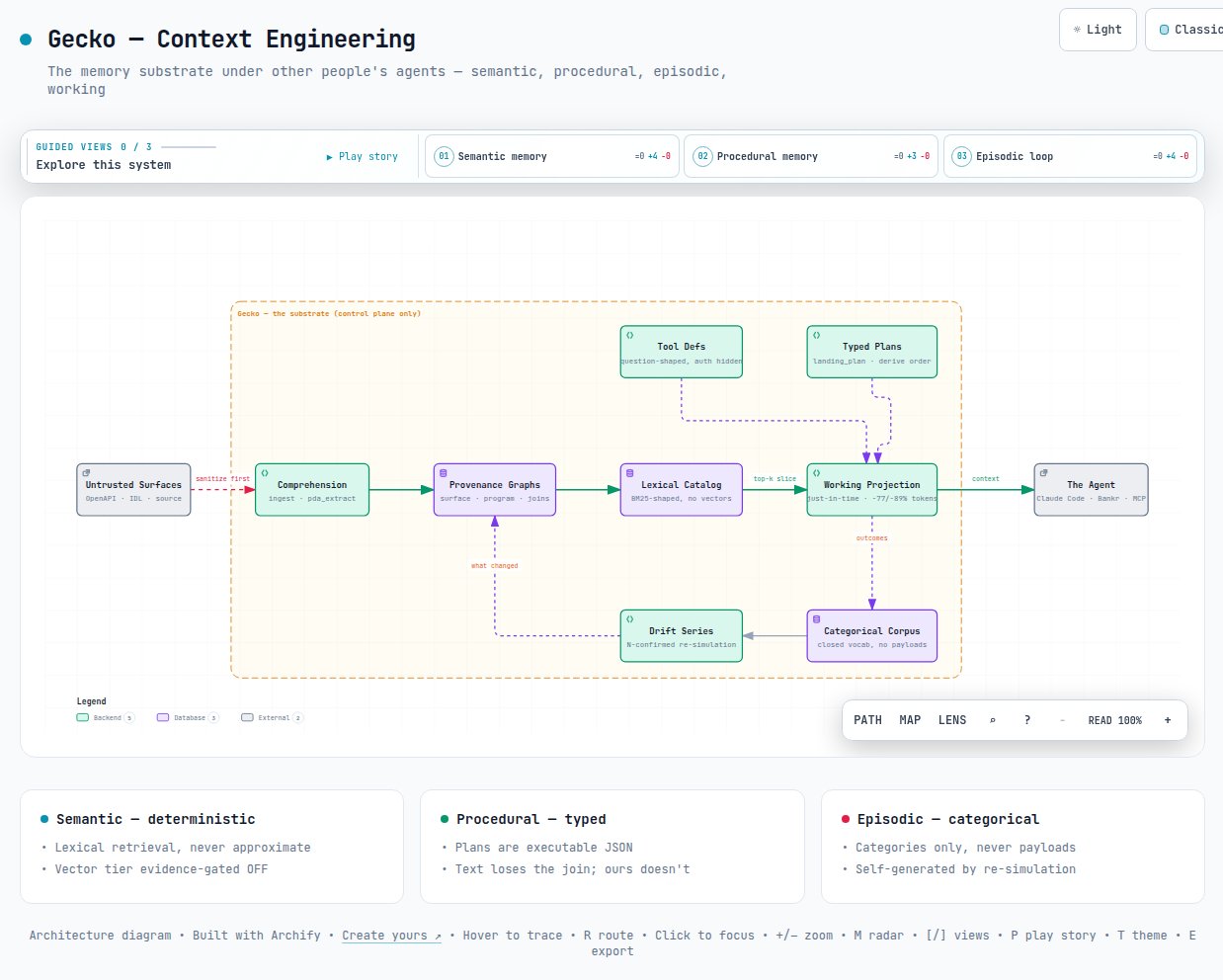 Gecko is **not the agent**. It is the memory-and-context substrate *under* other
people's agents. Every block of the canonical agent-memory architecture exists here, and
three of them are deliberately different from the textbook.
| Block | What Gecko does | Why it differs |
| - | - | - |
| **Semantic memory** | comprehended surfaces + a lexical, token-overlap catalog | the graph never *approximately* remembers; BM25 and vector tiers both sit behind evidence gates that flip only on measured recall failure |
| **Procedural memory** | question-shaped tool defs (auth stripped) + typed plans (`landing_plan`, `derivation_order`) | plans are **executable JSON** a builder can run; text loses the join, typed data can't |
| **Episodic memory** | a categorical corpus (closed vocabularies, never payloads) + an N-confirmed drift series | Gecko **generates its own episodes** by re-simulating; no dependence on your data plane |
| **Working memory** | just-in-time projection: scale-adaptive tool listing, full defs withheld above scale and recovered per tool on demand | measured context cuts of **−77% / −89%** on two real specs (bytes measured, tokens estimated) |
Retrieval quality is fed by a misrank-aware evaluation: a golden set plus a closed
miss-cause vocabulary, so the lexical-vs-semantic gate gets data instead of a guess.
The diagram above is a render. The **interactive** version (pan, zoom, guided
views, PNG/SVG export) ships in the repo as a single self-contained file:
[`docs/assets/architecture-context.html`](https://github.com/GeckoVision/gecko-surf/blob/main/docs/assets/architecture-context.html).
Download it and open it locally; it needs no server and no network.
***
## View 2: The full pipeline (sources → knowledge → action)
Gecko is **not the agent**. It is the memory-and-context substrate *under* other
people's agents. Every block of the canonical agent-memory architecture exists here, and
three of them are deliberately different from the textbook.
| Block | What Gecko does | Why it differs |
| - | - | - |
| **Semantic memory** | comprehended surfaces + a lexical, token-overlap catalog | the graph never *approximately* remembers; BM25 and vector tiers both sit behind evidence gates that flip only on measured recall failure |
| **Procedural memory** | question-shaped tool defs (auth stripped) + typed plans (`landing_plan`, `derivation_order`) | plans are **executable JSON** a builder can run; text loses the join, typed data can't |
| **Episodic memory** | a categorical corpus (closed vocabularies, never payloads) + an N-confirmed drift series | Gecko **generates its own episodes** by re-simulating; no dependence on your data plane |
| **Working memory** | just-in-time projection: scale-adaptive tool listing, full defs withheld above scale and recovered per tool on demand | measured context cuts of **−77% / −89%** on two real specs (bytes measured, tokens estimated) |
Retrieval quality is fed by a misrank-aware evaluation: a golden set plus a closed
miss-cause vocabulary, so the lexical-vs-semantic gate gets data instead of a guess.
The diagram above is a render. The **interactive** version (pan, zoom, guided
views, PNG/SVG export) ships in the repo as a single self-contained file:
[`docs/assets/architecture-context.html`](https://github.com/GeckoVision/gecko-surf/blob/main/docs/assets/architecture-context.html).
Download it and open it locally; it needs no server and no network.
***
## View 2: The full pipeline (sources → knowledge → action)
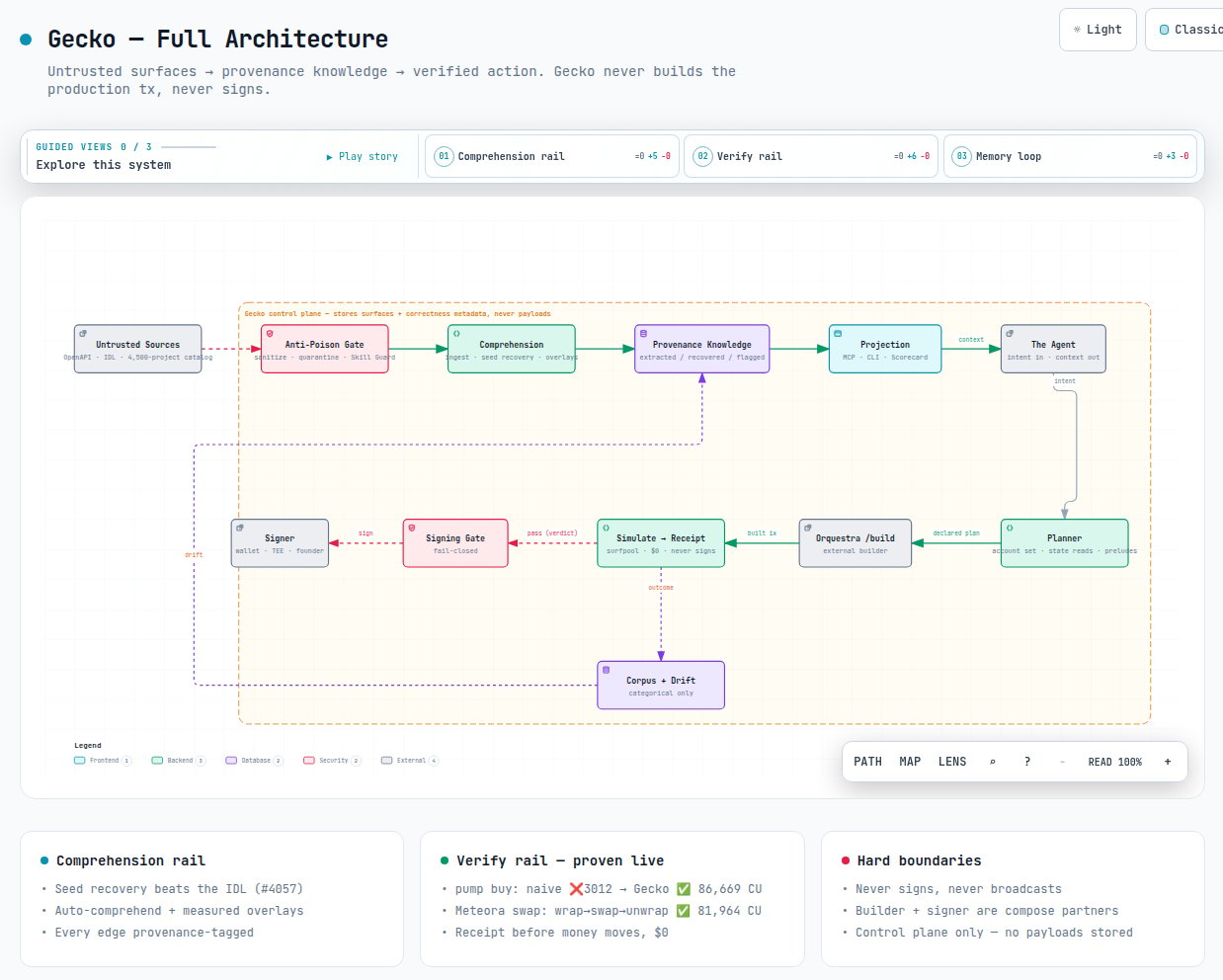 OpenAPI, human docs, `llms.txt`, Anchor IDLs, raw program source (Steel and native
too), and a 4,500-project on-chain catalog. Everything ingested is treated as
hostile input.
Spec sanitizer, per-tool quarantine, image Skill Guard (rendered-pixel payloads and
encoded-content rescan), SSRF netguard, out-of-band auth-host anchoring. Fail-closed.
Ingest to normalized `Operation` / `Param`; PDA seed recovery from IDL **and** source
(source rescues what the IDL structurally drops); auto-comprehend on pick, which
emits a generated config plus a **measured overlay** of what could not be derived
from any public surface.
Surface graph: `EXTRACTED` > `DECLARED` > `INFERRED` > `CLAIMED` → `VERIFIED` /
`REFUTED`. Program graph: `EXTRACTED` / `RECOVERED` / `FLAGGED`. Cross-API
correlations join on **declared** value domains first.
MCP (hosted, stdio, npx/uvx), the CLI, the Scorecard, and the Playground.
Auth headers never appear in a tool def.
`plan_*` returns the full account set plus state-read args and landing preludes → an
**external builder** builds → Gecko simulates the exact bytes → a **Receipt** with a
`binding` over those bytes → an **external signer** (wallet / TEE / human) signs →
`verify_signed_transaction` proves the signed bytes are the checked ones →
`submit_transaction` relays them, and refuses anything that does not verify.
A categorical outcome (never a payload) can be recorded on explicit opt-in, feeding
the drift series, which feeds back into the graph.
**The hard boundaries:** Gecko never signs, never holds a key, never proxies the data
plane. Building and signing belong to compose partners. That is the design, not a gap.
The one send path it ships relays only signed bytes that verify against its own binding.
The diagram above is a render. The **interactive** version (pan, zoom, guided
views, PNG/SVG export) ships in the repo as a single self-contained file:
[`docs/assets/architecture.html`](https://github.com/GeckoVision/gecko-surf/blob/main/docs/assets/architecture.html).
Download it and open it locally; it needs no server and no network.
***
## View 3: The on-chain action path (the proven loop)
OpenAPI, human docs, `llms.txt`, Anchor IDLs, raw program source (Steel and native
too), and a 4,500-project on-chain catalog. Everything ingested is treated as
hostile input.
Spec sanitizer, per-tool quarantine, image Skill Guard (rendered-pixel payloads and
encoded-content rescan), SSRF netguard, out-of-band auth-host anchoring. Fail-closed.
Ingest to normalized `Operation` / `Param`; PDA seed recovery from IDL **and** source
(source rescues what the IDL structurally drops); auto-comprehend on pick, which
emits a generated config plus a **measured overlay** of what could not be derived
from any public surface.
Surface graph: `EXTRACTED` > `DECLARED` > `INFERRED` > `CLAIMED` → `VERIFIED` /
`REFUTED`. Program graph: `EXTRACTED` / `RECOVERED` / `FLAGGED`. Cross-API
correlations join on **declared** value domains first.
MCP (hosted, stdio, npx/uvx), the CLI, the Scorecard, and the Playground.
Auth headers never appear in a tool def.
`plan_*` returns the full account set plus state-read args and landing preludes → an
**external builder** builds → Gecko simulates the exact bytes → a **Receipt** with a
`binding` over those bytes → an **external signer** (wallet / TEE / human) signs →
`verify_signed_transaction` proves the signed bytes are the checked ones →
`submit_transaction` relays them, and refuses anything that does not verify.
A categorical outcome (never a payload) can be recorded on explicit opt-in, feeding
the drift series, which feeds back into the graph.
**The hard boundaries:** Gecko never signs, never holds a key, never proxies the data
plane. Building and signing belong to compose partners. That is the design, not a gap.
The one send path it ships relays only signed bytes that verify against its own binding.
The diagram above is a render. The **interactive** version (pan, zoom, guided
views, PNG/SVG export) ships in the repo as a single self-contained file:
[`docs/assets/architecture.html`](https://github.com/GeckoVision/gecko-surf/blob/main/docs/assets/architecture.html).
Download it and open it locally; it needs no server and no network.
***
## View 3: The on-chain action path (the proven loop)
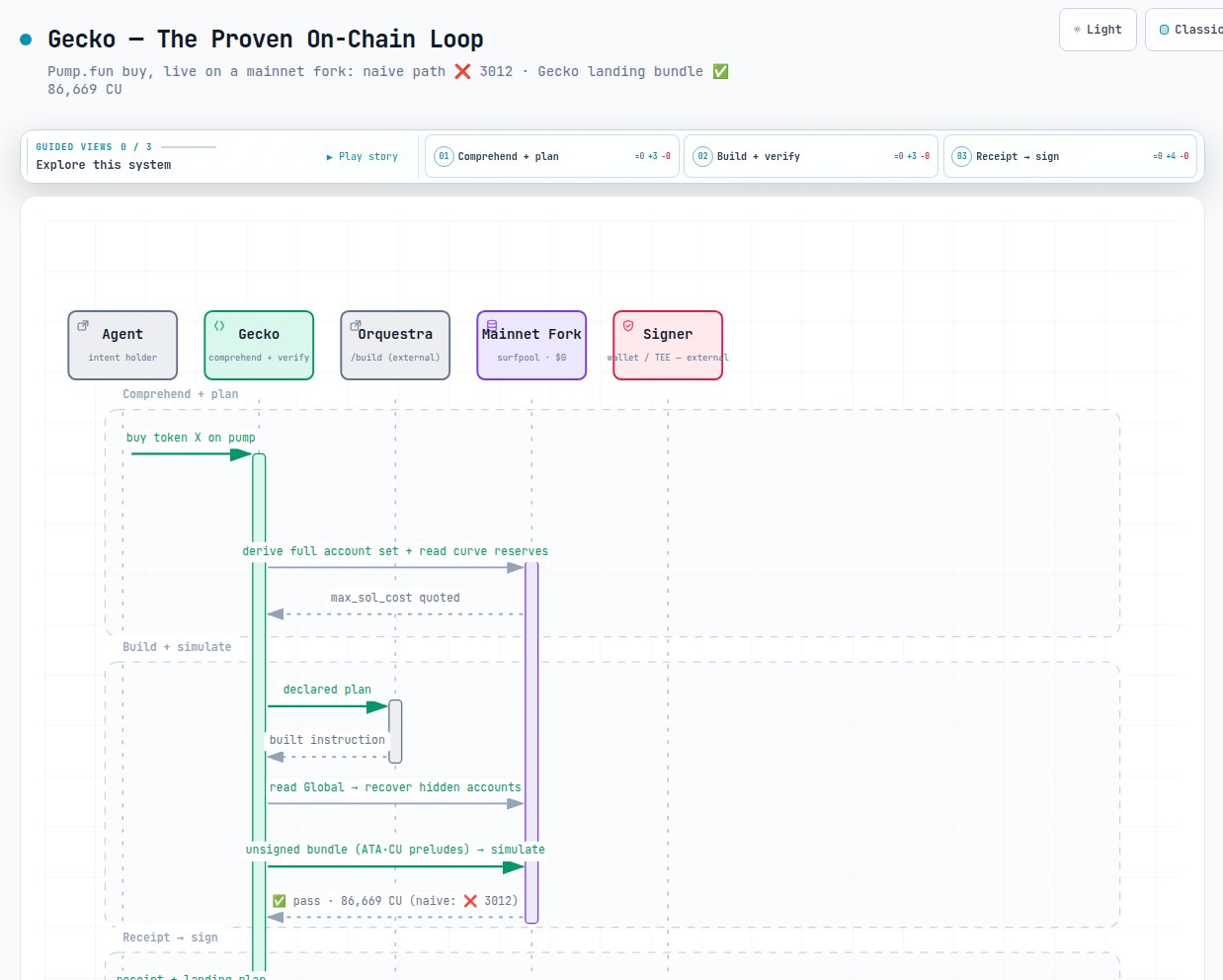 1. **Intent**: "buy this token", "swap SOL for USDC on this pool".
2. **Derive** the full account set, including accounts the IDL hides
(`bonding_curve_v2`) and seeds recovered from source (`base_factor`).
3. **State reads** (control plane) for sane arguments, e.g. curve reserves →
`max_sol_cost`.
4. **External build**: the plan goes to the builder; the builder returns the instruction.
5. **Unsigned prelude assembly**, for simulation only: idempotent ATA creation, wSOL
wrap/unwrap, compute budget. On the money paths, a fresh blockhash is patched in at
the offset the layout dictates, so the simulated bytes are the bytes handed back.
6. **Simulate**: `simulateTransaction` with `sigVerify:false`, on a fork or against a
public mainnet RPC.
7. **Receipt + binding**: status, categorical revert class, compute units, and a hash
over the exact message bytes at `exact` strength. → [The Receipt](/receipt)
8. **External signer** signs. Then `verify_signed_transaction` checks the signed bytes
against the binding, and `submit_transaction` relays them only if that check passes.
Gecko never signs. Unsigned assembly for simulation is the one documented carve-out, and
it is enforced at the landing layer by an AST check that proves that layer contains no
signing or sending path. The one sending path, `submit_transaction`, lives outside it and
is structurally unable to relay bytes without a binding.
The diagram above is a render. The **interactive** version (pan, zoom, guided
views, PNG/SVG export) ships in the repo as a single self-contained file:
[`docs/assets/architecture-onchain.html`](https://github.com/GeckoVision/gecko-surf/blob/main/docs/assets/architecture-onchain.html).
Download it and open it locally; it needs no server and no network.
***
## Invariants
Stores the API surface, tool defs, and correctness metadata only, never response
payloads, user data, or secrets.
Everything API-specific reduces to data (the spec) plus one adapter seam,
`Session.auth_headers()`. Adding an API doesn't touch ingest/catalog/tools/caller.
`recorded` and `live` differ only at the transport edge. The free offline
simulation comes first; live smoke is the final check.
Tool defs never expose auth headers. The agent describes intent; Gecko injects
credentials at call time from your OS keychain.
No keypair on any path. The landing layer has no sign or send path, AST-enforced.
`submit_transaction` relays only signed bytes that verify against a Gecko binding.
Unknown facts are `FLAGGED`, not invented. Below the retrieval floor the answer is
an honest no-start.
## Module map
The comprehension logic is the product and lives in the package; the MCP server, the
client, and the scripts are thin transport.
| Module | Responsibility |
| - | - |
| `gecko/ingest.py` | OpenAPI 3.x → normalized `Operation` / `Param` (`$ref` resolution, cycle/depth guarded) |
| `gecko/catalog.py` | Lexical capability search (intent → endpoint) |
| `gecko/tools.py` | `Operation` → question-shaped agent tool defs (**auth hidden**) |
| `gecko/caller.py` | tool + args → correct `PreparedRequest` (stdlib `urllib`) |
| `gecko/access.py` | `Session.auth_headers()`, the engine/adapter seam |
| `gecko/provenance.py` | the one canonical provenance vocabulary, shared by both graphs |
| `gecko/program_graph.py`, `gecko/pda.py` | the on-chain instruction↔PDA graph and derivation order |
| `gecko/find_start.py` | intent → the right (program, instruction) start point |
| `gecko/simulate.py` | the simulate→**Receipt** engine |
| `gecko/prepare_purchase.py`, `gecko/prepare_instruction.py` | plan, build once, simulate the exact bytes, return them unsigned with the binding |
| `gecko/verify_signed.py`, `gecko/submit_transaction.py` | signed bytes against the binding; relay-and-rebroadcast, refused without a binding |
| `gecko/corpus.py`, `gecko/drift.py` | categorical outcomes and the N-confirmed drift series |
| `gecko/sample.py` | deterministic schema → example (powers \$0 recorded mode) |
| `gecko/client.py` | `AgentApiClient`: `search` / `list_tools` / `prepare` / `call` |
| `gecko/mcp_server.py` | `McpSurface`, the agent-facing MCP surface |
## The one seam that matters
Adding a new API should not require touching ingest, catalog, tools, or the caller. The
only API-specific code is, at most, an auth adapter, an object that implements:
```python theme={null}
def auth_headers(self) -> dict[str, str]: ...
```
A public API uses the built-in no-auth adapter (returns `{}`); a paywalled API supplies
a session that returns its tokens. See [Access & auth](/access-and-auth).
## Security posture
* Ingested spec, doc, IDL, and source content is treated as **untrusted input**.
* URLs are validated before fetching (no SSRF: private/loopback/link-local ranges and
non-http schemes blocked). A caller-supplied `rpc_url` goes through the same guard.
* Secrets resolve from the OS keychain at call time and are never logged or persisted;
errors redact tokens before they're raised.
* Seven fail-closed security layers: spec sanitizer · per-tool quarantine · image Skill
Guard · SSRF netguard · out-of-band auth anchoring · the signing gate that checks
signed bytes against the receipt's binding · the AST-enforced no-sign boundary on the
landing layer.
The agent-readable version of this page is
[`architecture.llms.txt`](https://github.com/GeckoVision/gecko-surf/blob/main/architecture.llms.txt)
in the engine repo: the same three views plus the honest works / not-built split. See
also [Status](/status).
This documentation is built and hosted on [Mintlify](https://mintlify.com), a developer documentation platform.
1. **Intent**: "buy this token", "swap SOL for USDC on this pool".
2. **Derive** the full account set, including accounts the IDL hides
(`bonding_curve_v2`) and seeds recovered from source (`base_factor`).
3. **State reads** (control plane) for sane arguments, e.g. curve reserves →
`max_sol_cost`.
4. **External build**: the plan goes to the builder; the builder returns the instruction.
5. **Unsigned prelude assembly**, for simulation only: idempotent ATA creation, wSOL
wrap/unwrap, compute budget. On the money paths, a fresh blockhash is patched in at
the offset the layout dictates, so the simulated bytes are the bytes handed back.
6. **Simulate**: `simulateTransaction` with `sigVerify:false`, on a fork or against a
public mainnet RPC.
7. **Receipt + binding**: status, categorical revert class, compute units, and a hash
over the exact message bytes at `exact` strength. → [The Receipt](/receipt)
8. **External signer** signs. Then `verify_signed_transaction` checks the signed bytes
against the binding, and `submit_transaction` relays them only if that check passes.
Gecko never signs. Unsigned assembly for simulation is the one documented carve-out, and
it is enforced at the landing layer by an AST check that proves that layer contains no
signing or sending path. The one sending path, `submit_transaction`, lives outside it and
is structurally unable to relay bytes without a binding.
The diagram above is a render. The **interactive** version (pan, zoom, guided
views, PNG/SVG export) ships in the repo as a single self-contained file:
[`docs/assets/architecture-onchain.html`](https://github.com/GeckoVision/gecko-surf/blob/main/docs/assets/architecture-onchain.html).
Download it and open it locally; it needs no server and no network.
***
## Invariants
Stores the API surface, tool defs, and correctness metadata only, never response
payloads, user data, or secrets.
Everything API-specific reduces to data (the spec) plus one adapter seam,
`Session.auth_headers()`. Adding an API doesn't touch ingest/catalog/tools/caller.
`recorded` and `live` differ only at the transport edge. The free offline
simulation comes first; live smoke is the final check.
Tool defs never expose auth headers. The agent describes intent; Gecko injects
credentials at call time from your OS keychain.
No keypair on any path. The landing layer has no sign or send path, AST-enforced.
`submit_transaction` relays only signed bytes that verify against a Gecko binding.
Unknown facts are `FLAGGED`, not invented. Below the retrieval floor the answer is
an honest no-start.
## Module map
The comprehension logic is the product and lives in the package; the MCP server, the
client, and the scripts are thin transport.
| Module | Responsibility |
| - | - |
| `gecko/ingest.py` | OpenAPI 3.x → normalized `Operation` / `Param` (`$ref` resolution, cycle/depth guarded) |
| `gecko/catalog.py` | Lexical capability search (intent → endpoint) |
| `gecko/tools.py` | `Operation` → question-shaped agent tool defs (**auth hidden**) |
| `gecko/caller.py` | tool + args → correct `PreparedRequest` (stdlib `urllib`) |
| `gecko/access.py` | `Session.auth_headers()`, the engine/adapter seam |
| `gecko/provenance.py` | the one canonical provenance vocabulary, shared by both graphs |
| `gecko/program_graph.py`, `gecko/pda.py` | the on-chain instruction↔PDA graph and derivation order |
| `gecko/find_start.py` | intent → the right (program, instruction) start point |
| `gecko/simulate.py` | the simulate→**Receipt** engine |
| `gecko/prepare_purchase.py`, `gecko/prepare_instruction.py` | plan, build once, simulate the exact bytes, return them unsigned with the binding |
| `gecko/verify_signed.py`, `gecko/submit_transaction.py` | signed bytes against the binding; relay-and-rebroadcast, refused without a binding |
| `gecko/corpus.py`, `gecko/drift.py` | categorical outcomes and the N-confirmed drift series |
| `gecko/sample.py` | deterministic schema → example (powers \$0 recorded mode) |
| `gecko/client.py` | `AgentApiClient`: `search` / `list_tools` / `prepare` / `call` |
| `gecko/mcp_server.py` | `McpSurface`, the agent-facing MCP surface |
## The one seam that matters
Adding a new API should not require touching ingest, catalog, tools, or the caller. The
only API-specific code is, at most, an auth adapter, an object that implements:
```python theme={null}
def auth_headers(self) -> dict[str, str]: ...
```
A public API uses the built-in no-auth adapter (returns `{}`); a paywalled API supplies
a session that returns its tokens. See [Access & auth](/access-and-auth).
## Security posture
* Ingested spec, doc, IDL, and source content is treated as **untrusted input**.
* URLs are validated before fetching (no SSRF: private/loopback/link-local ranges and
non-http schemes blocked). A caller-supplied `rpc_url` goes through the same guard.
* Secrets resolve from the OS keychain at call time and are never logged or persisted;
errors redact tokens before they're raised.
* Seven fail-closed security layers: spec sanitizer · per-tool quarantine · image Skill
Guard · SSRF netguard · out-of-band auth anchoring · the signing gate that checks
signed bytes against the receipt's binding · the AST-enforced no-sign boundary on the
landing layer.
The agent-readable version of this page is
[`architecture.llms.txt`](https://github.com/GeckoVision/gecko-surf/blob/main/architecture.llms.txt)
in the engine repo: the same three views plus the honest works / not-built split. See
also [Status](/status).
This documentation is built and hosted on [Mintlify](https://mintlify.com), a developer documentation platform.